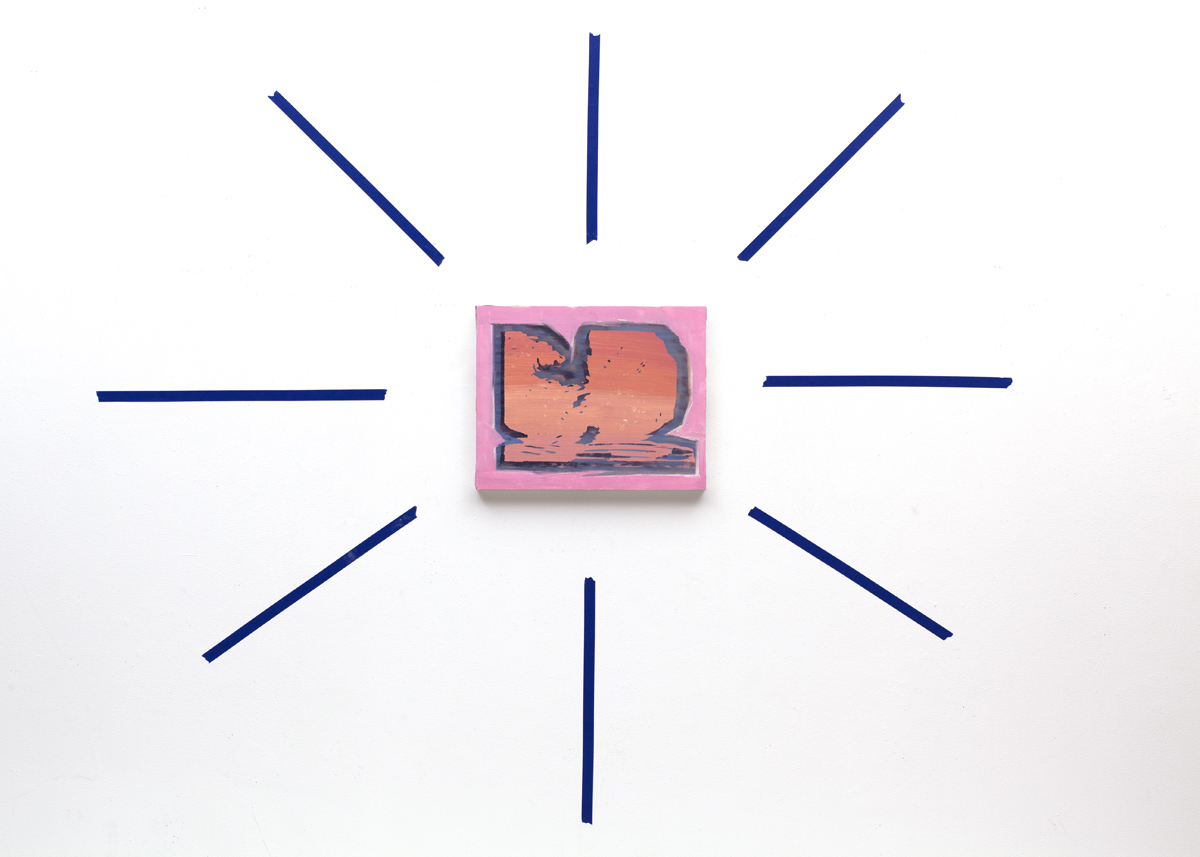
These are materially driven works that teeter somewhere
between painting and object. Attention
to the moment of the application of paint is of interest.
Thursday, October 13, 2016
Saturday, September 10, 2016
Solo Show @ How's Howard Gallery, Boston, MA, November 2016
Gearing up for show at How's Howard project space @ http://www.howshoward.com/about/ 450 Harrison Ave Suite 309c in the South End of Boston. It's in the artists' studio building directly above Thayer St. galleries! Come by for the opening on First Friday, November 4, 2016 6-8pm!
Friday, October 23, 2015
Thursday, August 20, 2015
of sarah sze
[Note: I wrote this a couple of years ago but just got around to editing/posting]
When I first saw an installation of Sarah Sze's work at the MFA/Boston in 2002, I was struck with her use of small fans, which activated the bits of materials that made up the bulk of the piece. It seemed the air currents created animation to the work in ways that the artist couldn't totally predict. This animation throughout the rambling piece-- spanning 2 floors--helped elevate the work beyond a mere catalog of the work of an obsessive- compulsive. I recently heard Jerry Saltz say that good art gives off more energy than went into its making. The fans, in large part, help lift (literally) Sze's work into this category.
In my own work, I've been dealing with a sort of double exposure imagery/ off -set printing style marks. It's a process that yields a kind of animation or movement in the work.
Sometimes I think what stands out in others' work, are answers to the things we're tackling in our own.
Sarah Sze's installation at Tanya Bonakdar gallery, 2010
More examples of this: I remember seeing an Art 21 video of Kara Walker showing her cutting silhouetted figures from a big roll of paper. She seemed "in a groove" as she sliced through the paper with sure, continuous cuts. In that very same Art21 episode, Elizabeth Murray sketched onto clear mylar sheeting with a sharpie, using fluid, continuous movement. Something about both their quick, almost athletic actions stayed with me.
This idea of work that comes quickly, and often in one shot has been a touchstone. I have a "need for speed" in the studio, and so much the better if it shows in the product.
Back to the double exposure paintings. The process removes a static-ness, in a way, I hope, similar to the use of fans by Sze. It's a riff on a printmaking process, but made alla prima with oil paint- the quicker, less controlled the better.
A tendency is to make the processes in the studio into art--I guess that's a Bruce Neuman notion I've internalized. For me, support materials and tendencies in the studios, find ways into the work itself.
Nauman made the following assumption: “If I was an artist and I was in the studio, then whatever I was doing in the studio must be art.
So reference and support materials--xeroxes, postcards, painter's tape, (even studio furniture)- instead of being jumping off points, become the actual focus, and in some cases, the actual art.
Support materials, activities in studio:
Nauman made the following assumption: “If I was an artist and I was in the studio, then whatever I was doing in the studio must be art.
So reference and support materials--xeroxes, postcards, painter's tape, (even studio furniture)- instead of being jumping off points, become the actual focus, and in some cases, the actual art.
Support materials, activities in studio:
Postcards
painter's tape
resting paintings on chairs while re-arranging work on walls.
Sunday, May 3, 2015
Tuesday, April 7, 2015
Spring Update
The paintings are focused on surface of late, with interest in what look like off register marks comprising the "all-over" surface.
And some have gotten more complex...
(works in progress)
More shifts as of mid-April--away from all-over.
And some have gotten more complex...
More shifts as of mid-April--away from all-over.
Saturday, December 27, 2014
Tuesday, July 1, 2014
The Incramentalists
Dealing here with a silhouetted form, altered incrementally from painting to painting.
The ambiguity of the image opens up options (and space) in a way
that moves the series ahead
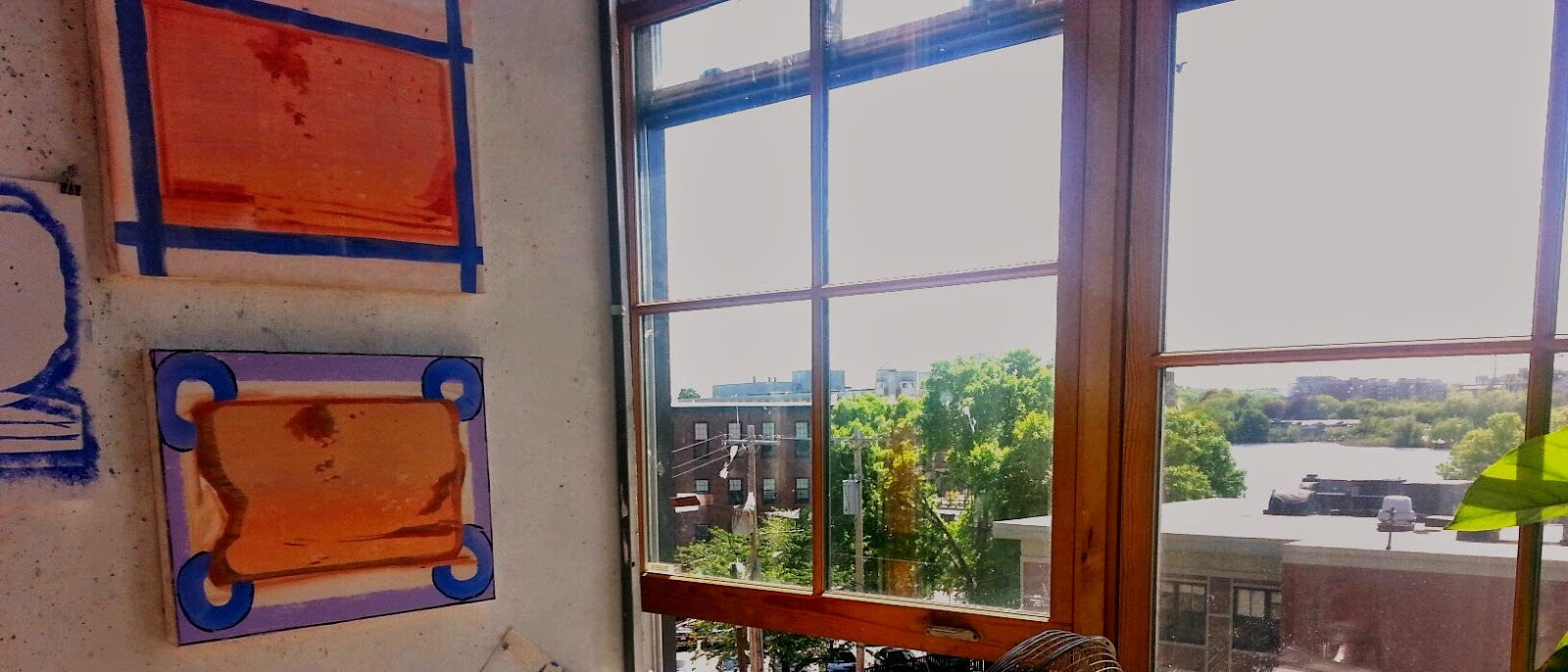
Within the body of work there's a nod to the studio itself, with inclusion of support materials like painter's tape. It claims space on the wall, making painting-objects.
Paintings in Chairs
These are mostly not staged --- there's simply a tendency to place paintings in a safe spot while rearranging the studio. However a lot of ideas tend to grow out of this sort of regular activity. Here are a number of seated-paintings I've documented over the past months.
Saturday, May 31, 2014
a different direction
Well maybe not so new...but somewhat so:
Hard to articulate what's going on here since it's only days old. The subject matter is the same I've been working with for past couple of months, but here the process is even more evident and layered. There's almost a rough-hewn quality to the painting. The green is inspired, I am sure, by the bright new- leaf growth on the trees outside my studio window. Paintings do have a way of staying in sync with the seasons.
Studio window overlooking Charles River and Moody Street, Waltham, MA (and Brandeis in the distance!)
I checked my "list of references" post from 1/29/14 about repeated themes in the work, to see how many are still at play:
Cartoon influence:Yes, still see this in current work.
The body: Yes, still see this reference.
The landscape: For sure see reference...more so, even.
The studio: Not so much. This might be the difference between painting during winter vs. late spring.
Past tendency of exposing painting panel at edges: Yes, this theme remains an interest, takes different guises. I think it also has to do with my over-arching interest in silhouetted form.
Another variation on the same theme is below, from earlier in the spring--a de-saturated, overall
simpler version. Something different it has from the painting above-- a sense of buoyancy.
Saturday, February 22, 2014
Wednesday, January 29, 2014
Framing (or People, Places, Things)
Studio journal, 1/29/14.
Things or references cropping up in paintings lately:
Comics
The body
The landscape
The studio
Past tendency of exposing painting panel at edges.
Sunday, September 29, 2013
Spacey
This work from late summer into early fall 2013, shifts between the painterly poles of establishing pictorial space versus the "paint- as- paint" grit of the actual surface.
The silhouetted forms at once both assign and deny a certain spatial depth.
Now, late-fall, a "surround" or framing
device has developed that establishes another level to the fore-mid-background distances. It's a sort of fore-foreground.
the framing device, but is apparent in the imagery itself--how much (or how little) information is needed?
(And I guess the idea of working with silhouetted forms is yet another form of editing/decision -making.)
Monday, June 24, 2013
Monday, February 18, 2013
Describing Geometry
I recently had a studio visit from two painters, each of whose work I really respect. A comment during the visit has stayed with me. It was about how the radiating marks in my newest paintings,"describe the dimensions of the panel."
I've been aware of
this as a recurring tendency for a while, but it is helpful to hear someone else
find a way to articulate it.
I later thought that this sort of modular formation (pictured above) begins to describe the dimensions and geometry of the space.
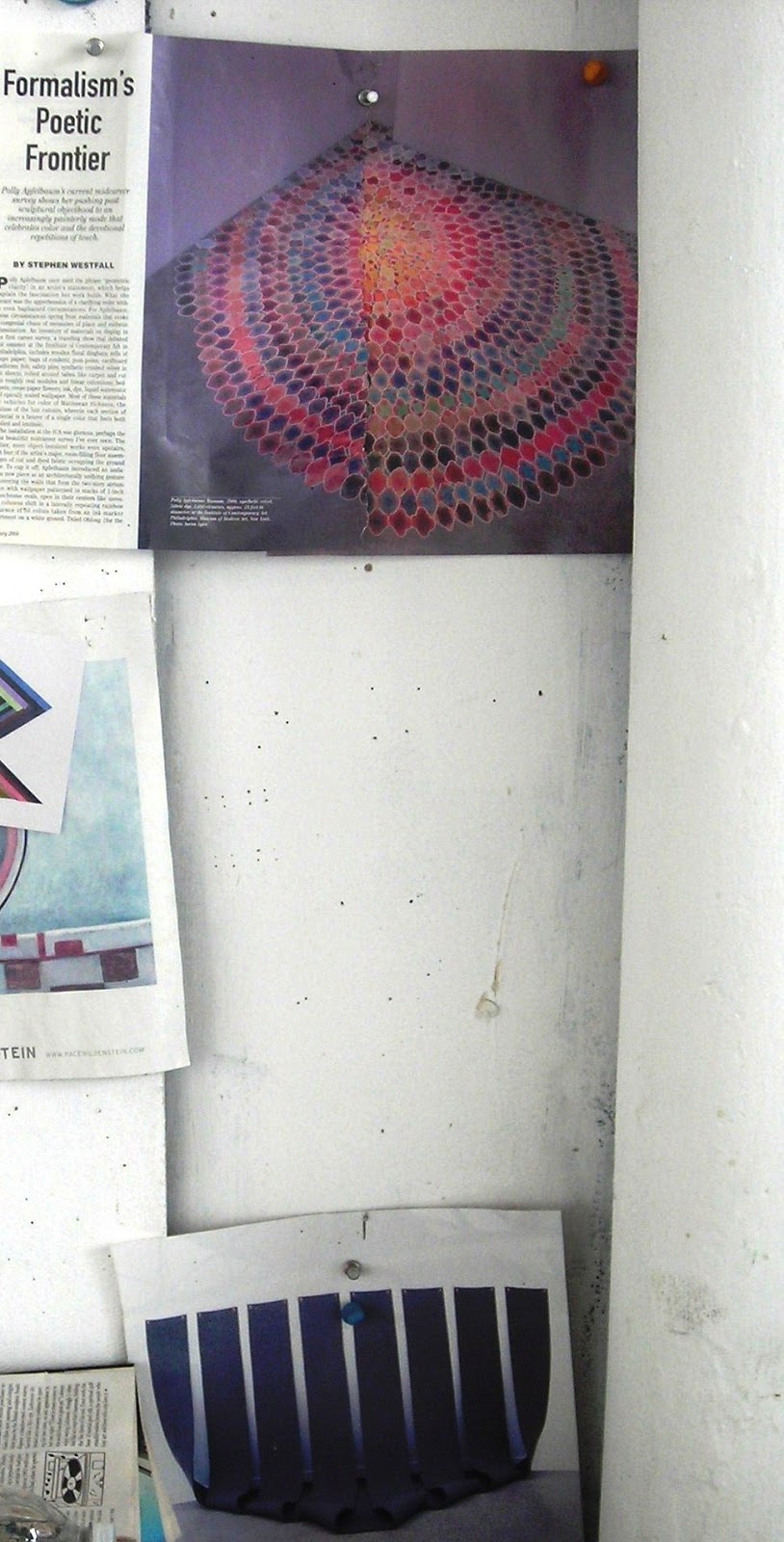
Apflebaum, floor piece (at top), Morris, felt piece (at bottom).
Above is a shot of my studio wall where two images of work by artists I admire that have hung longer than any other of the handful I have up. For a long time I couldn't make a connection between these works and mine. But now that I see the theme of describing dimensions, or geometry, as central to the work itself (and importantly, how it dictates outcome) I am beginning to see a link.
detail, Polly Apfelbaum, floor piece
detail, Robert Morris, felt piece.
Subscribe to:
Posts (Atom)